


by Ann Brysbaert, Professor in Ancient Technologies, Materials and Crafts, Faculty of Archaeology, Leiden University. She is also the Director of the Netherland Institute at Athens, Greece.
***
For quite some time, I knew about this seemingly small place of the Textile Research Centre (TRC) in Leiden (as seen from the outside). Initially, I never found it open when I passed by on my walks, although the fascination for it was always there.
Eventually, I looked it up online in 2021, and found out that a famous textile scholar ran it: Dr. Gillian Vogelsang-Eastwood, a name all too familiar to 2nd year students of the BSc. (Hons, now MSc.) conservation course at UCL, which I took in the mid-90s, and which incorporated a course on the materials, technologies and conservation issues relating to woven materials and textiles.
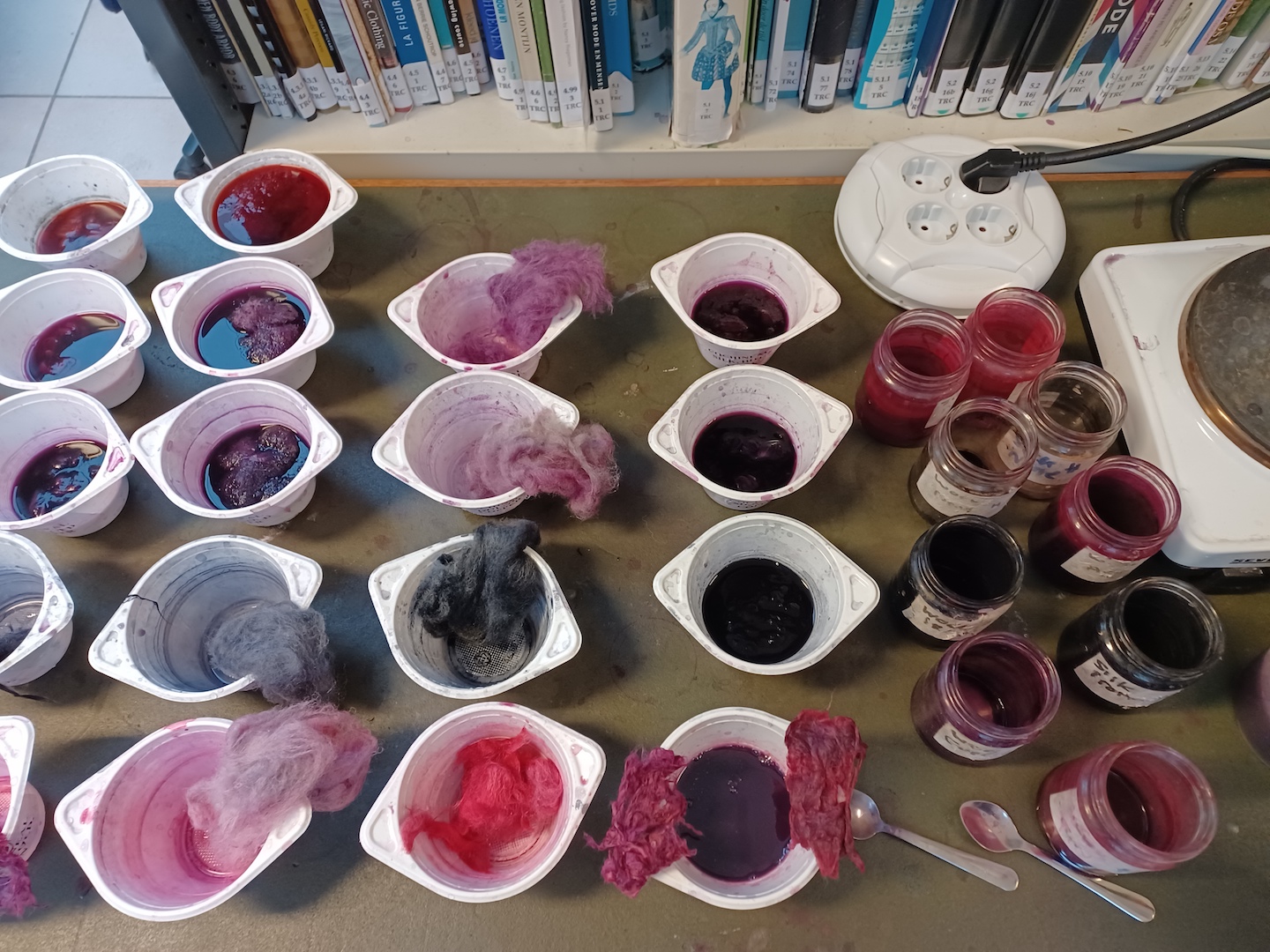 Dyeing experiments with different types of fibres in cochineal-and-mordant solution. Photograph by author.
Eventually in 2022, as an academic teacher at Leiden University on ancient materials, technologies and crafts, I took my students to Gillian’s Textile Research Centre, where she gave us all a wonderful practical of about 2 hours, catered to the course content I taught that time (just post-Covid) for BA 2 students on organic materials and technologies in pre-industrial contexts.
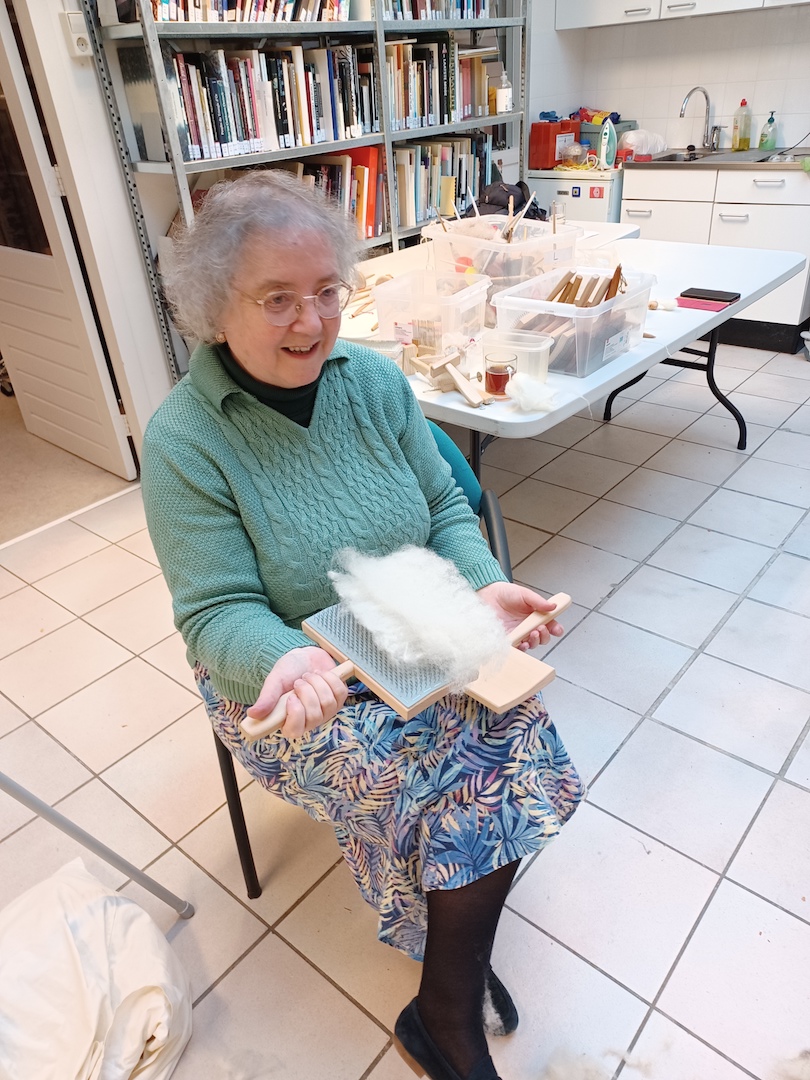 Gillian happily carding wool. Photograph by author.Afterwards, seeing my students very satisfied on what they learnt there, I felt that I wanted to do more with this topic, and that Gillian had far more to teach me, so when I saw her textile course advertised at the end October 2024, I knew what I was going to do before the Christmas holidays.
The five enrolled course students arrived on Monday 9 December, at 8.30am. It was still dark outside, but we hid in a warm workshop space, where a very colourful exhibition on shisha work from India was displayed. Gillian had sent us in advance the detailed programme and plenty of documentation we were going to use, and had mentioned, en passant, that she provided tea, coffee and biscuits, but that we could also bring our own.
And so it was that we forgot very quickly the dark and cold winter days outside, when in her capable hands. Together with several of her volunteers and research associates, Gillian showed us around an unimaginably large and varied collection of self-collected and donated textiles and related accessories, being all stored in this seemingly small place. It represented a life-time biography of travel, of meetings between people, of trust by many people in her capability to safeguard their materials and their stories.
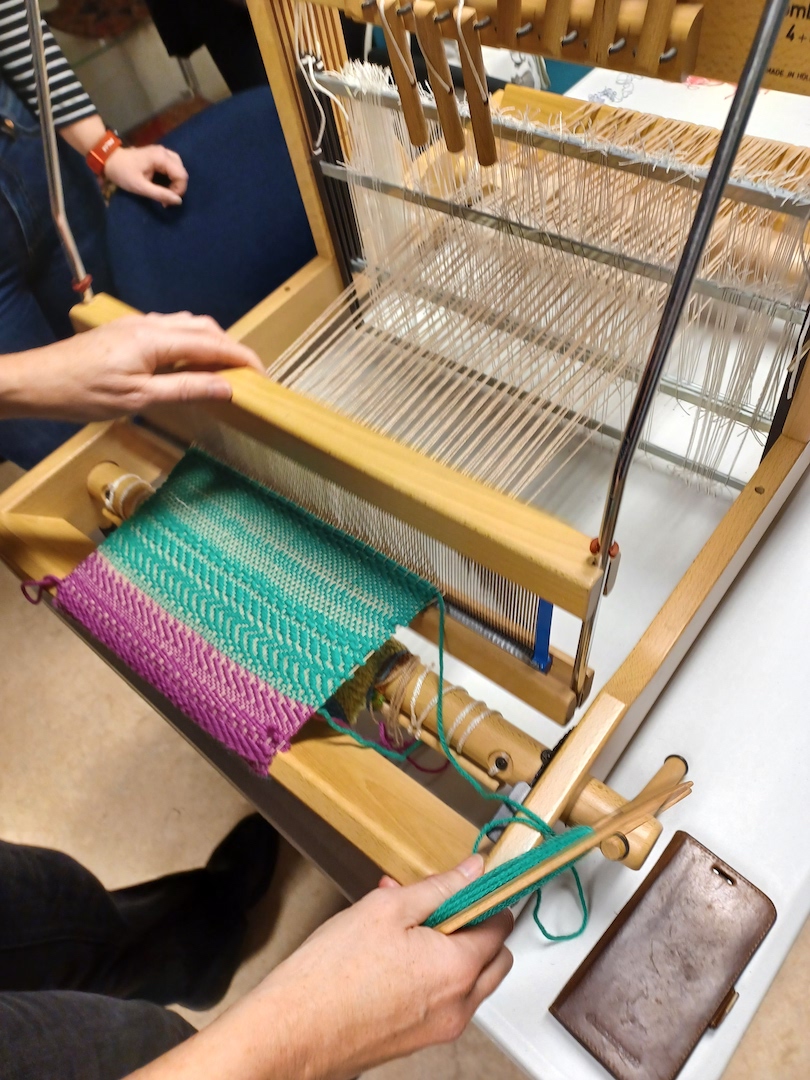 Weaving experiments in different patterns. Photograph by author.First impressions (of a small place), though, can deceive: the TRC is absolutely vast as regards depth: not only as regards the building, but also in terms of (1) content – it currently houses close to 50,000 items, all catalogued and accessible online – and in terms of (2) professional knowledge and skills gathered there. Many materials and items present at TRC have been studied and published, and Gillian keeps on writing volumes of the Bloomsbury World Encyclopedia of Embroidery, a lifework in progress.
The five students of the course were very varied in background, the only thing that we had in common was that we were all women and we all loved textiles: for the same or other reasons, or both. And this was enough to bond very quickly and learn from each other, as each of us knew already something, or had already done something.
Gillian told us there were three types of students: the dyers, the weavers, and the spinners, and while we all realized that this was not a way to restrict our capacities to one skill, our natural gift (and liking) did tend to go to one or the other.
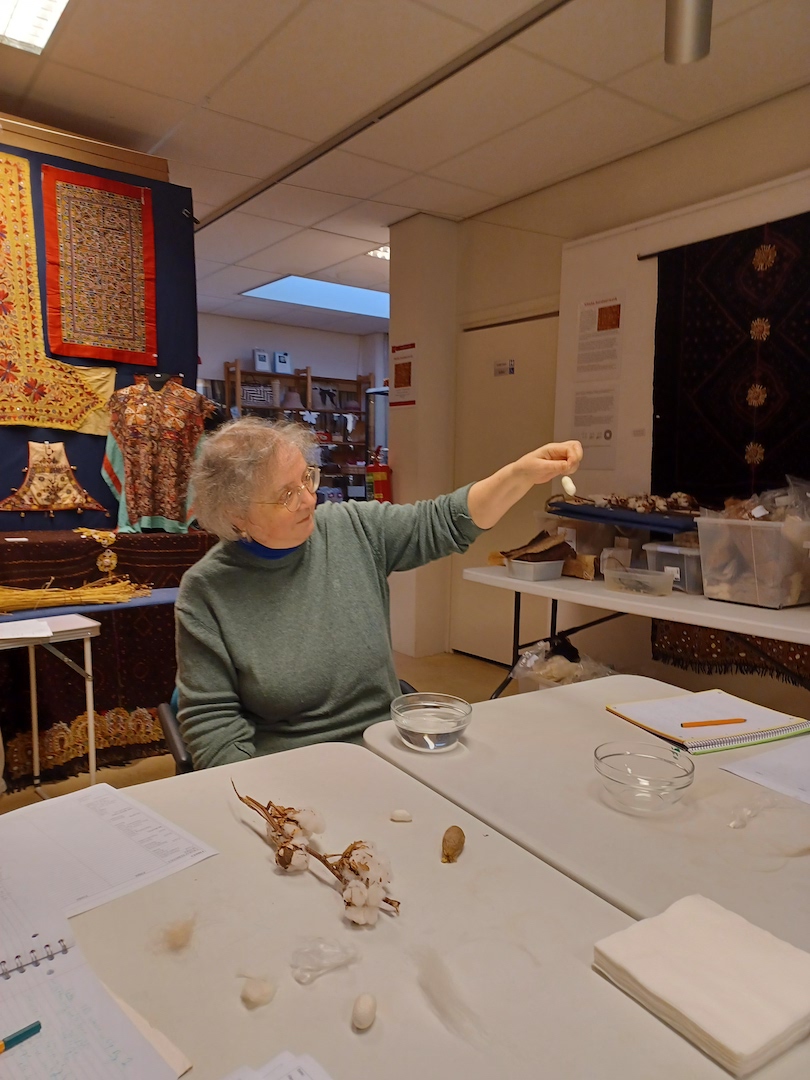 Gillian holding cocoon by its silk thread. In the background the exhibition on the wall, and the library in the distance. Photograph by author.I was not versed with the spinning (it was the first time and I was very keen to do it), and I got frustrated after a while, but thought: “little girls learned this from their mothers, aunts, and grandmothers over the years, so I don’t need to know how to do this in a few hours having reached mid-life already”.
Patience is a virtue, and this is one of the elements, I guess, we all learnt at the course: finding that we were all excited and eager to learn, but getting frustrated sooner or later when we did not grasp things as fast as we wanted. What the rat-race world makes of us was neatly undone during this course, like Penelope’s woven burial shroud each night.
Over the days of this week in December, we learnt a huge amount of new skills: carding wool, spinning, dying and working with the much needed chemicals and mordants, and also weaving, even making velvet. There was nothing we did not touch or try, and we had, next to hard work, plenty of cookies and healthy laughs. Lunch breaks tended to be skipped to take in more, but Gillian also taught us to take a proper break to let the new information sink in.
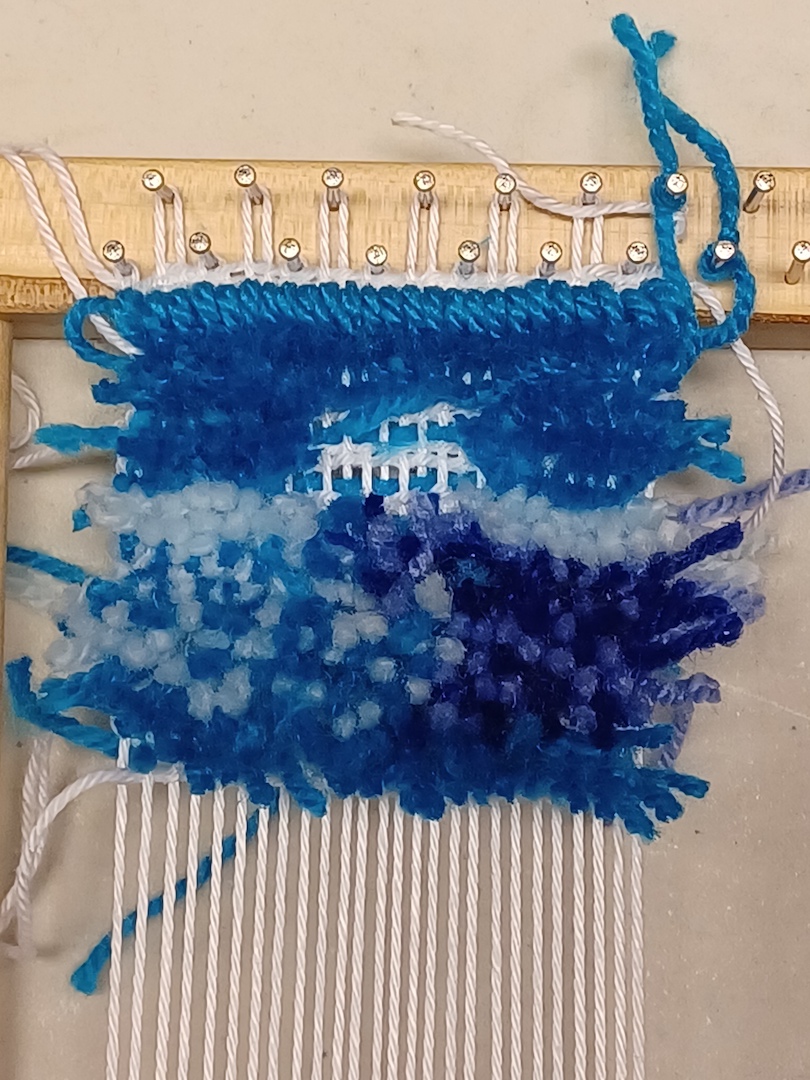 The trying world of self-made velvet. Photograph by author.And as she promised, we were tired at the end of each day, and certainly at the end of the week. We spent the last few days learning to ‘read’ more and more complex works of textile, from an incredible range of cultures and mix of materials.
These were crafted from many simple and complex technological methods, and fabrics ranged from simple black to eye-hurting coloured prints, from the poor feed sacks turned into colourful printed dresses, to royal garments that took years of handwork to produce just one.
The TRC at Leiden had it all, combined with an incredible library on everything textile and related (for the onlne catalogue, click here). And the best thing was: we could touch and open it all! Objects you expect in national museums or wealthy private collections (and we only saw a fraction of the richness of it) were there for us to touch, feel, admire, love or hate, and learn from.
We were also encouraged to make a sort of sample portfolio: ranging from all possible fibres (goat hair, silk cocoons, merino wool) to samples of complex velvet structures that would flicker, under different light angles, by their amazing patterns. Now that I properly organized this portfolio over the Christmas break, it turns out that it fills an entire large ring binder, and only then I realized exactly how much we had learned that week.
There was not a boring moment that week, and there was a wonderfully warm community-feeling between the c. 10 total strangers to each other (Gillian, volunteers and researchers, us). During our final beer together on the last evening in the café next door, the five of us already forged plans for coming back next year for another course with Gillian, on one or another aspect of her encyclopaedic knowledge she may want to share with us.
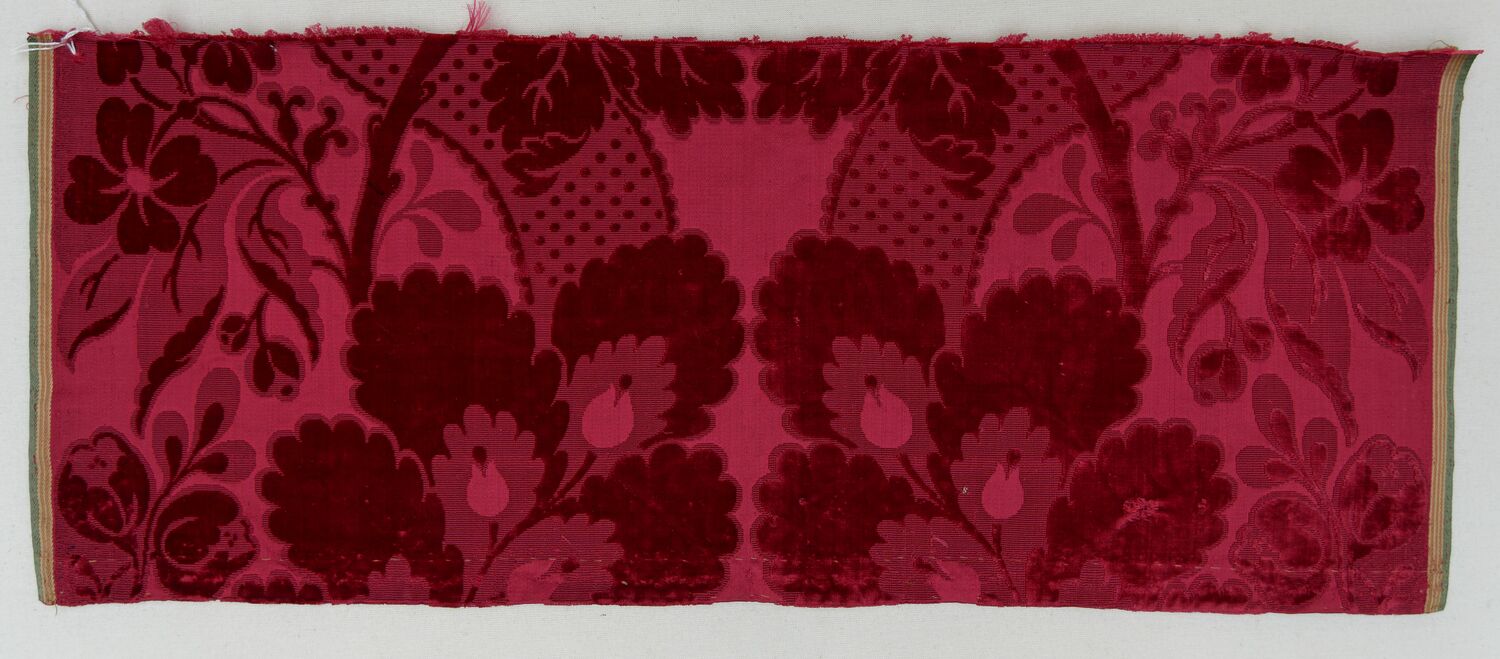 Sample of 18th century velvet, probably from Italy (TRC 2011.0389 4).
Whether another joint course together with us five will materialize remains to be seen, but one thing is sure: this small place at Leiden holds a grand collection, is run by a grand lady, and should be housed in a grand new place soon. There is talk of new premises, but things are not sure or clear yet. We can only hope that this TRC, which has so much to offer to the outside world of archaeologists, conservators, students, teachers, crafts people, designers, and artists alike, will continue to thrive and amaze everyone who makes the effort to walk into this seemingly small place.
Leiden, 8 Febr. 2025
For more information about the Intensive Textile Course, please click here. The course will again be given from 7-11 April; 23-27 June; 25-29 Aug, and 27-31 Oct. 2025.


