• F2
  • F4
  • F3
  • F1

The TRC Object of the Month for August 2012 is a blue and cream silk robe à l’anglaise for a girl, dating from the late 18th century and worn in the Netherlands. The dress is open at the front and only closes at the bodice with a series of little hooks and eyes. The fabric is a taffeta lancé with narrow vertical lines in warp satin and fine sprig motifs in weft floats using a secondary cream weft. The dress can be admired at the TRC Gallery throughout the month of August.18th century girl's dress, Robe à l'Anglaise. Front view. TRC Nr. 2007.0732

In the 18th century children were almost similarly dressed to their same-sex adults. There were no special childrens' colours and only a few garments were exclusive  for children. It is difficult to say what the daily dress consisted of, because in paintings and portraits ‘common’ children are seldom depicted and most records are of court style dress worn by aristocratic children. Like the clothing of the 16th and 17th centuries, 18th century clothing of  children was based on the idea of formality of appearance. For a girl that would mean a chemise - a loose undergarment worn next to the skin - , stays, a petticoat, which was sometimes visible, stockings, garters, pockets, a dress, an apron (not worn with the open robes) , cap and shoes. Significant changes occurred after the 1770-80s, when lighter dresses came into fashion, ending with Neo-Classical draperie inspired dresses with high waists. But until then the wearing of stays was also for children believed to be wholesome, because it was thought to support the back and the digestive organs. Also the wearing of hats and caps at all times was thought to prevent illness by keeping the head warm.

TRC number: 2007.0785; 2007.0944; loan                                          


Description:


Swimwear from the Netherlands

a.Woolen swimsuit, male, 1920s; b. Cotton swimsuit, female, late 1950s; c. Polyamide bikini, female, late 1980s


The TRC Object of the Month for July is a set of swimwear dating from the last century and worn in the Netherlands. The dark blue swimsuit is a woolen  men’s swimsuit, machine knitted and worn in the 1920s at the Dutch coast. The blue-cream swimsuit is a female suit made of woven cotton and fully wrinkled with elastic, dating from the later ‘50s. The bikini is made of polyamide and dates from the late 1980s.

Bathing in sea came in vogue not earlier than at the end of the eighteenth century. At first it was a rather serious business with a strong medical character. The salt water was thought to be wholesome by disorders like asthma, arthritis, ulcers, hernia and for the bathing a special therapy program was used, including the drinking of sea water. Originally bathing huts , also called bathing machines were driven into the breakers, where the patients were submitted naked to the waves by attendants called dippers. The strict moral standards of the time soon made dressed bathing the norm. Bathing costume did not differ very much from daily summer dress. Women even let their  corset under their dresses, to prevent  the wet cloths to show their body shape. Only in 1880 the one-piece swimsuit  was introduced, which also made women wearing pants for the first time. The early swimsuits were made of knitted wool, but soon more comfortable materials were used. The lady’s swimsuit, made by the Dutch company Tweka, shows a good improvement and the fabric was even patented as Tweka telescopic.The introduction of synthetic fibres such as Nylon, Helanca and the today Lycra allowed an even better shape. These quick drying materials guaranteed form maintenance during swimming, but also didn’t let you with a soaking afterwards.
Swimsuits more and more became a fashion article, the blue-cream swimsuit bears a label of the renowned Dutch fashion house Gebroeders Gerzon’s Modemagazijnen N.V. (1889-1968). The 1970s tended to more and more exposed body and hence less material. This now seems to have reached the top: swimsuits anno 2012 increasingly have a concealing shape with a figure corrective interior to let the woman swim as flattering as possible.


Keywords: Clothing, swimwear

Object type: two swimsuits, one male(a) and one female(b); bikini(c)

Local name: badpak; bikini

Country: Netherlands

Date: 1920s; late 1950(-early‘60s); late 1980s(-early‘90s)

Materials: wool; cotton and elastic; polyamide

Techniques: machine knitted; machine woven and machine sewn and wrinkled; machine knitted
Dimensions: H75cm x W50cm; H70cm x W45cm; H22cm x W45cm + H12cm x W45cm


TRC number: 2007.0785; 2007.0944; loan  


TRC number: 2007.0785; 2007.0944; loan                                            


Further reading:
Ferry, Kathreen, Beach Huts and Bathing Machines, Shire, 2009
 Galjaard, J.M. ,  Pootje Baden: de vaderlandse geschiedenis van het badleven, Utrecht, 1966
  Hemmen, P. van, De geschiedenis van de badmode. TWEKA 75, 1916-1991, Nuenen ,1991
  Kessels, J.A.W., Het Huis GerzonGeschiedenis van een Modehuis, 1889-1964, Uitgave: Gebr. Gerzon`s Modemagazijnen N.V., 1964
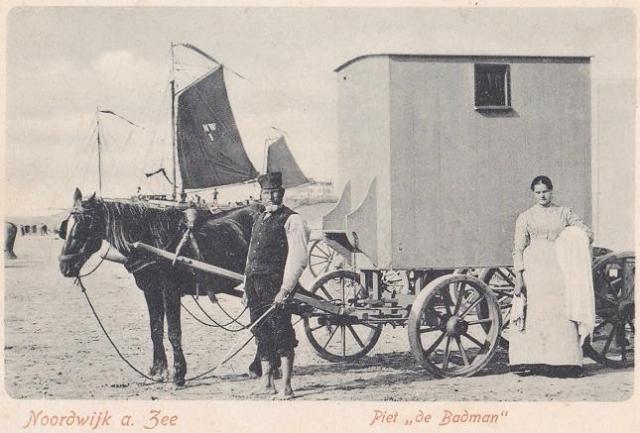


Bathing machines on the beach of Noordwijk, Netherlands and driven into the breakers. Late 19th century

Badkoetsen op het Noordwijkse strand en doorrijdend tot in de branding . Eind 19e eeuw

(Bron: http://www.dekker-bu9.nl/genealogie/bedijn/gen_Bedijn.htm; http://nl.wikipedia.org/wiki/Badkoets)


                               Man wearing a woolen swimsuit, 1934
Man in wollen herenbadpak, 1934


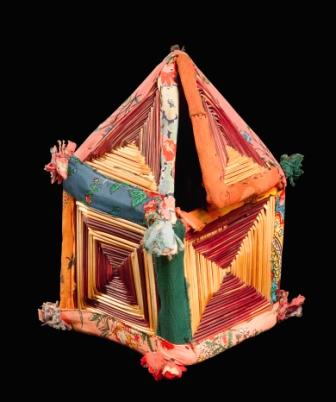
Object of the Month for June 2012 is a beautiful sewing box from Syria. The box, which is now on display at the TRC, is made from dark purple and natural coloured straw. The lengths of straw were first dyed and then woven into squares and triangles. These were then sewn together to create the base section and the lid of the box. The seams of the sewing box are further decorated with stripes of various types of cotton and synthetic cloth decorated with flower motifs, as well as damask and plain cloth. The corners of the box have small tassels made from short lengths of cloth bundled together. Each tassel is made from one type of cloth rather than a mixture.A southern Syrian sewing box. TRC Collection, Acc. No. 2005.0132A southern Syrian sewing box. TRC Collection, Acc. No. 2005.0132

These boxes are said to take the form of little houses with the lid acting as the roof of the ‘building.’ Examples of similar sewing boxes from southern Syria also tend to be made with simple tassels on the upper corners of the box and the apex of the lid. In contrast, early to mid-20thcentury examples from Jordan and Israel/Palestine were often elaborately decorated all over with silk tassels attached to the four top corners, and diamond shaped amulets sewn to the four bottom corners of the box. The amulets were made of straw.

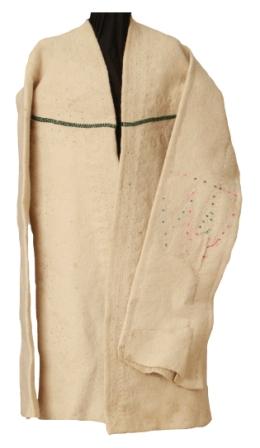
The TRC object of the month for April 2012, selected and described by Kayle Harris (TRC intern from Leiden University) was a coat (khosai) from Uruzgan Province in southern Afghanistan, made from locally produced felt. It is decorated with hand embroidery and includes small geometric motifs in white thread with small dots in blue, yellow, pink, and green.  This particular khosai was made in 2009 specifically for Dr. Willem Vogelsang, Leiden, after seeing another example and talking about this type of garment  with the district chief.  Old man from Uruzgan, South Afghanistan, wearing a khosai coat. Spring 2009. Photograph: Willem VogelsangOld man from Uruzgan, South Afghanistan, wearing a khosai coat. Spring 2009. Photograph: Willem VogelsangIt took about a year for the various elements of the garments to be organised, such as collecting the sheep’s wool, making the felt, adding the detailed embroidery, and so forth. 

 This type of heavy felt coat, or khosai, was traditionally worn by shepherds  in the lowlands of southern Afghanistan and the high mountain pastures in the centre of the country. Such heavy garments were necessary in order to help keep the wearer warm, especially during cold winter nights.  Many of these shepherds were Pashtuns who form Afghanistan’s largest ethnic group and live along both sides of the modern Afghanistan-Pakistan border.A khosai coat from Uruzgan, South Afghanistan. TRC collection.A khosai coat from Uruzgan, South Afghanistan. TRC collection.

These coats are noteworthy for their exceptionally long sleeves that are not meant to be used, instead the garment is draped over the shoulders like a cloak. In this particular case this garment has two small hand pouches at the chest to keep the front sections of the coat closed.  Coats with long, false sleeves are worn throughout Central Asia, Afghanistan, and parts of Iran. Such coats that can be made of other types of textiles such as silk, and have a long history going back to the first millennium BC.  The ancient Greeks, for example, recount stories about how in the presence of kings the subjects would put their arms in the sleeves as a sign of respect to make sure they could not use their weapons.


  • Keywords: Coat
  • Local Name: khosai
  • Country: Afghanistan
  • Region/Group: Pashtun
  • Date: 2009
  • Materials: Felt; synthetic fibre; silver coloured thread; synthetic velvet
  • Techniques: Embroidered; hand-sewn; applied band; felted; couched
  • Dimensions: H 122 cm x W 54 cm
  • ID Number: 2010.0087 

Further Reading:

Vogelsang, Willem, 2005, “Dressing for the future in ancient garb: the use of clothing in Afghan politics,” Khil’a 1.

Vogelsang, Willem, 2007, “What Afghan men used to wear in the early nineteenth century: the Right Honourable Mountstuart Elphinstone and his account of the Kingdom of Kabul,” Khil’a 3.

The TRC object of the month is a bridal outfit from India. It has been selected and described by Angeliki Karakonstanti (TRC intern from Leiden University). It can be admired at the TRC for the whole of May 2012. The outfit consists of a red skirt (lehenga) with matching blouse (choli) and shawl (chunni). The skirt (lehenga) is ankle length and very full. The blouse (choli) has short sleeves and decorative buttons down the front. Both the skirt and blouse are made from heavy silk and lined with cotton. The shawl consists of a large rectangle of a fine, red gauze. All of the garments are decorated with heavy, hand embroidered patterns of zardozi (a special form of Indian embroidery).

Search in the TRC website

Contact

Boerhaavelaan 6
2334 EN Leiden.
Tel. +31 (0)6 28830428  
office@trcleiden.org 

facebook 2015 logo detail 

instagram vernieuwt uiterlijk en logo


Bank account number

NL39 INGB 0002 9823 59, in the name of the Stichting Textile Research Centre.

TRC closed until 4 May 2026

The TRC is closed to the public until Monday, 4 May 2026, due to our move to the Boerhaavelaan. The TRC remains in contact via the web, telephone and email. For direct contact and personal visits, please contact the TRC at office@trcleiden.org, or by mobile, 06-28830428.

Donations

The TRC is dependent on project support and individual donations. All of our work is being carried out by volunteers. To support the TRC activities, we therefore welcome your financial assistance: donations can be transferred to bank account number (IBAN) NL39 INGB 000 298 2359, in the name of the Stichting Textile Research Centre. BIC code is: INGBNL2A.

 You can also, very simply, if you have an iDEAL app, use the iDEAL button and fill in the amount of support you want to donate: 


Since the TRC is officially recognised as a non-profit making cultural institution (ANBI), donations are tax deductible for 125% for individuals, and 150% for commercial companies. For more information, click here